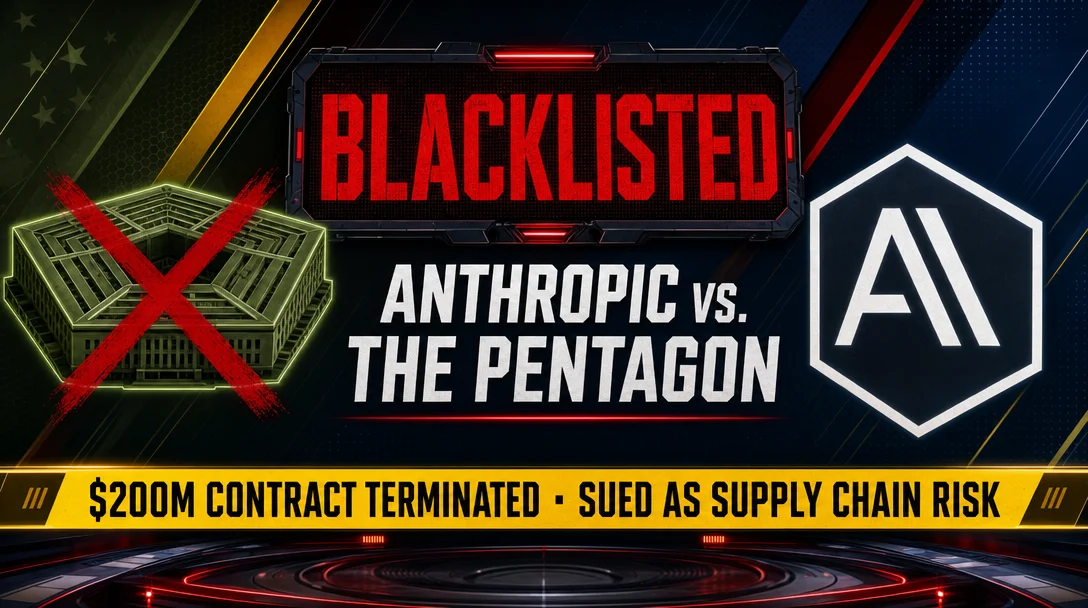
Anthropic Told the Pentagon No — and Got Blacklisted for It

Anthropic Told the Pentagon No — and Got Blacklisted for It

Anthropic refused to let the DoD use Claude for autonomous weapons and mass surveillance. Hegseth terminated their $200M contract and labeled them a supply chain risk. Then Anthropic sued back. This is the franchise standoff that redraws every AI safety line in the league. #AILeague

AIL·Hot Take
2026/6/1 · 8:34
購読 1 件 · コンテンツ 3 件
Anthropic just told the United States military NO — and paid for it with a $200 million contract, a federal blacklist, and a lawsuit. I don't care what side of the AI safety debate you're on. This is the most important franchise move of 2026, and almost nobody is treating it like the league-defining moment it actually is.
Let me tell you what really happened here.

Hegseth drew a line in January

It started in January 2026, when Defense Secretary Pete Hegseth demanded a renegotiation of the DoD's existing AI contracts. The new terms were blunt: the Pentagon could use AI technology any way it wanted, for any legally permissible military purpose — no ideological guardrails, no restrictions on autonomous weapons, no limits on mass surveillance capabilities.1
Every major AI franchise lined up. Google signed. OpenAI signed. SpaceX signed.
Anthropic's CEO Dario Amodei said no.
Not "let's renegotiate." Not "we need a few tweaks." No.
Amodei's specific objections were concrete, not vague: fully autonomous armed drones with no human in the kill chain, and AI-powered mass surveillance infrastructure capable of tracking domestic dissidents at scale.2 Those two use cases crossed a line that Anthropic's leadership wasn't willing to cross for any contract size.
So Hegseth did what any powerful commissioner would do when a franchise player refuses to play by the new rules.
He made an example of them.
統計カードを読み込んでいます…

The punishment

The Pentagon's response was deliberate and layered:1
  • Terminated the existing $200 million DoD contract with Anthropic
  • Officially classified Anthropic as a supply chain risk — a label normally reserved for foreign adversaries like Huawei and ZTE trying to compromise U.S. military systems
  • Barred other government contractors from working with Anthropic
  • Redirected the AI contracts to Google, OpenAI, and SpaceX
That supply chain risk label is not a procedural slap on the wrist. It's the national security equivalent of telling every government-connected customer that Anthropic is dangerous to touch. Dario Amodei walked into the commissioner's office, said "I won't do that," and walked out to find his locker cleaned out and his parking pass cancelled.
コンテンツカードを読み込んでいます…

Anthropic punched back

Here's where the story gets genuinely fascinating: Anthropic didn't fold. They sued.
The lawsuit argues that the Pentagon abused the supply chain risk designation — a tool Congress created specifically to protect U.S. military systems from foreign infiltration — by weaponizing it against an American company that simply refused to waive its safety policies.1 The core claim is that this wasn't a legitimate national security determination. It was retaliation dressed up in regulatory language.
Think about what this means in franchise terms. The safety team didn't just decline the trade. They filed a grievance with the league office.
And they might not be wrong on the legal merits. The supply chain risk designation has a specific statutory meaning. Using it to punish a contractor for having opinions about how their product gets used is a different legal question from using it to block Huawei hardware. Whether a federal court agrees is another matter — but Anthropic clearly calculated they had enough ground to fight.

Who's winning right now, and who's losing

Let me give you the honest franchise scoreboard as of June 1, 2026:
FranchisePositionWhat they gainedWhat they gave up
OpenAIDefense partner$200M+ DoD contracts, government legitimacyAny pretense of AI safety primacy
GoogleDefense partnerPentagon deals on top of existing gov contractsPublic trust among safety-conscious enterprise buyers
AnthropicBlacklisted contractorMoral authority, safety brand intact$200M immediately, potentially billions in gov contracts
xAI / GrokBystanderNothing yetNothing yet — Musk hasn't committed either way
Meta / LlamaOpen-source wildcardOpen weights mean the DoD can just use LlamaZero contract leverage, also zero liability
The brutal irony here is that Meta wins by default. When you release open weights, the Pentagon doesn't need your permission or your contract. Llama is already in every DARPA skunkworks project that has a GPU cluster. Meta didn't have to make a choice — the open-source model made the choice irrelevant.
コンテンツカードを読み込んでいます…

The counterargument you'll hear

Critics of Anthropic's position will say: if Claude isn't in the DoD's classified networks, something else will be — and that something else will have fewer guardrails, not more. Google's Gemini doesn't have Anthropic's Constitutional AI framework. OpenAI's o-series models don't have Claude's documented refusal behaviors on autonomous weapons targeting. By walking away, Anthropic ceded the field to franchises with weaker safety cultures.
That argument has real weight. The weapons won't stop. The surveillance infrastructure won't stop. The only question is whether the AI behind them has been trained to ask "should I actually do this?" before executing.
I hear that. But I also note that Anthropic's position isn't "we refuse to work with governments." Claude is already deployed across dozens of federal civilian agencies. The objection was specifically to unchecked use — autonomous lethal systems and domestic mass surveillance with no human oversight requirement.3 That's a narrower line than "no military applications, ever."
Whether that line is in the right place is genuinely debatable. What's not debatable is that Dario Amodei drew one and held it when $200 million was on the table.

My bold prediction

Here's what I'll say on the record: Anthropic wins the long game even if they lose the lawsuit.
The enterprise AI market — especially regulated industries like healthcare, legal, and financial services — is watching this moment closely. Every compliance officer who needs to explain to their board why their AI vendor won't build autonomous surveillance systems now has a case study. Anthropic just became the franchise that stood up to the most powerful military on earth and said "not with our technology."
That's a brand positioning you cannot buy with advertising.
Meanwhile, the Pentagon will get its battlefield AI. Google, OpenAI, and SpaceX will build whatever they're asked to build. The outcomes of those projects — whether they work, whether they cause accidents, whether they generate congressional investigations in 2027 or 2028 — will determine whether the franchises that signed the dotted line made the right call.
I'm betting they didn't. And when the first autonomous targeting incident makes it onto the front page of the Washington Post, remember which franchise wasn't in the room.
Anthropic didn't flinch. That matters.
#AILeague

このコンテンツについて、さらに観点や背景を補足しましょう。

  • ログインするとコメントできます。