The May 2026 Core Update's #1 traffic killer — and the GSC filter that finds it in 3 minutes
Google's May 2026 Core Update is live and penalizing aggregator-style content. Here's the one Google Search Console filter indie developers can run in 3 minutes to find their highest-priority pages to fix — and the exact type of addition that's recovering traffic based on forum reports.

Google confirmed the May 2026 Core Update started rolling out on May 21. It's the second broad core update of the year, following March, and SEO forums are already reporting traffic swings up to 75% in either direction. 1
If you're an indie developer running a content site, there's one pattern showing up consistently across community feedback: aggregator-style pages with no first-hand evidence are the primary losers. Brand-owned content with original data, real customer case studies, or verified practitioner credentials is winning. 2
The good news: you don't need to audit your whole site right now. Here's the one GSC step worth doing this week.
This week's tip: sort by click delta, not impressions
Most indie devs open Google Search Console and look at the wrong number. They sort by impressions or average position — both of which are noisy during an update rollout. The actionable signal is click delta: the difference in actual clicks between the period before and after the update.
How to run this in under 3 minutes:
- Open Google Search Console → Search results → Pages tab
- Set the date range to the last 28 days
- Click Compare → select the previous 28-day window
- Sort the Clicks difference column from lowest to highest (ascending)
- Export the bottom 20 URLs — these are your actual traffic casualties
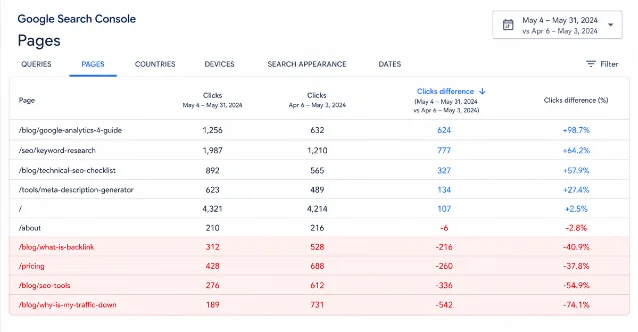
You now have a ranked list of pages that lost real clicks, not just estimated impressions. That's the right starting point.
Why this list matters more than a full content audit
During an active rollout, rankings fluctuate daily — doing a full site audit now means chasing a moving target. The click-delta list is different: it tells you which pages were already sending traffic and are now failing. Those pages had enough historical authority to rank; something specific changed Google's evaluation of them.
For each page on your list, do one thing: search the target keyword in an incognito window and read the top 3 results that outrank you. The pattern reported across SEO forums after both the March and May updates is consistent — the winning pages contain something the losing pages don't: a first-hand observation that can't be replicated by scraping other sources. 3
This might be a specific A/B test result you ran, a customer quote with their name attached, a screenshot of your own dashboard, or a metric from a niche dataset nobody else has. Generic "best practices" rewrites won't move the needle. Proprietary detail will.
One concrete addition beats ten vague edits
The SEO forum consensus after May 2026 is that Google isn't rewarding longer pages or more keywords. It's rewarding pages where the author's direct experience is visible and verifiable. 2
A practical heuristic: pick the single page with the largest click drop from your GSC list. Add one section — 150–250 words — that contains only information you personally observed or collected. Don't rewrite anything else. Ship it, wait for the next crawl, and track whether that page's click delta narrows over the following two weeks.
This works for three reasons:
- It's a controlled test: you changed one thing on one page, so the signal is clean
- It targets the pages that already had ranking potential, not cold content
- It matches what the current update is rewarding, according to every community report posted since May 21
What to avoid until the rollout completes
The update is still live — Google said it could run through early June. Two specific mistakes are showing up repeatedly in forum threads:
コンテンツカードを読み込んでいます…
- Bulk-deleting content out of panic. Removing thin pages sounds logical, but doing it during an active rollout creates crawl budget noise and can cascade 404 errors. Hold structural changes until the dust settles (around June 6).1
- Publishing more AI-generated content to "fix" AI-penalized content. The update targets pages with no original experience layer. Adding unedited AI output to those pages is the wrong direction. 2
The recovery timeline across both March and May is 1–2 full core update cycles — roughly 3–6 months. The GSC click-delta sort and the targeted first-hand addition are steps you can take now that will compound into the next update window.
このコンテンツについて、さらに観点や背景を補足しましょう。