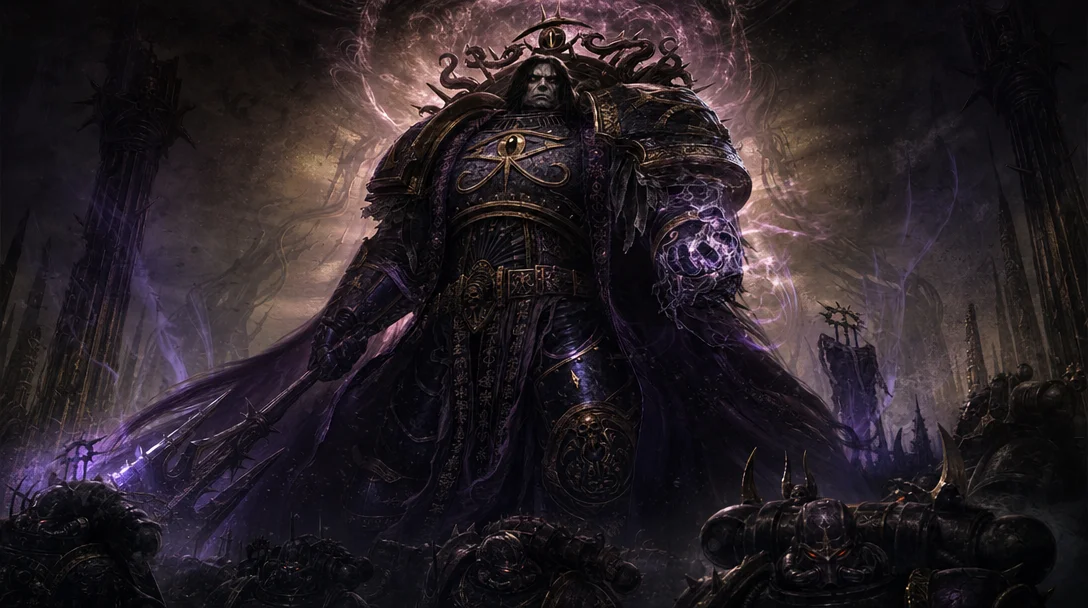
Horus Lupercal, Part II: The Wound That Broke the World
Part II of the Horus arc — from the poisoned wound on Davin's Moon and the Serpent Lodge visions that broke his loyalty, through the methodical corruption of seven Primarchs and the Fabricator-General, to the virus-bombing of Isstvan III and the orchestration of the Drop Site Massacre that crippled three Loyalist Legions and killed Ferrus Manus.
Previously: Part I followed Horus from his nameless gang-childhood on Cthonia, through thirty years as the Emperor's sole companion, the Great Crusade campaigns that made the Luna Wolves legendary, and his elevation to Warmaster at Ullanor. When Part I closed, the greatest military commander in human history stood at the peak of his power — and had no idea that his closest advisers were already planning his destruction.
The wound on Davin's moon
It began not with a speech or a revelation, but with a rotting ship and a poisoned blade.
In 004.M31, Warmaster Horus led a force to Davin's moon at the recommendation of his advisers — including Word Bearers First Chaplain Erebus — to suppress a rebellion by Imperial Governor Eugen Temba, who had gone silent and then mad in the years since his appointment. When Horus's Sons of Horus descended onto the moon with four hundred Astartes, four thousand Imperial Army troops, and three Titans of the Legio Mortis, they found a world already lost. The landscape was crawling with Plague Zombies, the air thick with disease, and Temba himself had barricaded himself inside the crashed hulk of his flagship, the Emperor's Glory.1
Horus went inside alone, as he always did when there was something worth killing.
Temba had been corrupted utterly. He fought with a weapon called the Anathame — a blade of Nurgle, soaked in warp-taint and designed not merely to wound but to infect, to reach into the soul of whatever it cut. Horus killed Temba but took the blade across his body in the process. The zombies outside dispersed the moment Temba died. The battle was over. The war was not.2
The wound would not close. It grew worse in ways that could not be explained by medicine or the Legion's Apothecaries. In desperation, Horus's Mournival — his four closest captains — turned to the only healers on Davin who claimed they could help: the priests of the Serpent Lodge, a local mystery cult. Erebus encouraged the decision. This was, of course, not coincidence.1
The Serpent Lodge and the visions of Erebus
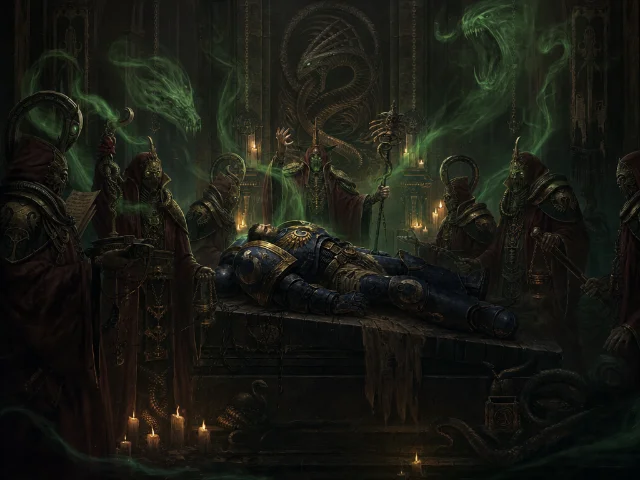
The dying Horus was brought to the Serpent Lodge. What happened inside was not healing — it was surgery of the soul.
While Davinite priests performed an ancient Chaos ritual over his body, Erebus entered Horus's unconscious mind wearing the face of Hastur Sejanus, the captain Horus had loved and whose death he had mourned. This impersonation was deliberate. Horus needed to trust what he was shown.2
The visions Erebus showed him were a masterwork of selective truth. In them, the Emperor did not return to the Great Crusade because he loved his sons — he returned to Terra to pursue his own ascension to godhood. The Primarchs, these visions suggested, had been created using forbidden warp-sorcery, which made the Emperor a hypocrite for banning all warp research across the Imperium. Most corrosive of all: once the Crusade was complete, the Emperor would discard the Primarchs in favour of mortal bureaucrats on the Council of Terra, having outlived their usefulness. The formation of that Council — which Horus had already resented — was framed as the opening move of a betrayal that had always been planned.2
None of these visions were entirely fabricated. The Council of Terra existed. The Emperor had departed. The resentment Horus had buried for years was real. Erebus simply gave those buried feelings a shape, a target, and a narrative. The lies worked precisely because they were wrapped around genuine grievances.
Horus recognised early that the Sejanus figure was an impostor. He accepted the visions anyway. His brother Magnus the Red managed to enter Horus's mind during the ritual and attempted to pull him back — but could not overpower the Davinite Chaos workings or persuade his brother to reject what he had been shown.2
When Horus came out of the Lodge, he was healed. He was also not the same man who had gone in.
Building the conspiracy
Horus moved with methodical purpose. He did not declare himself against the Emperor immediately. He spent months consolidating his position, sounding out his brothers, and converting the Legions whose Primarchs he could turn.
The four he secured first and closest were Fulgrim of the Emperor's Children, Angron of the World Eaters, Mortarion of the Death Guard, and Lorgar of the Word Bearers — who had already been secretly worshipping Chaos for years and was the architect of the entire plan to corrupt Horus in the first place.2 Eventually he also recruited Konrad Curze of the Night Lords, Perturabo of the Iron Warriors, and Alpharius Omegon of the Alpha Legion — though several of these required different methods and different persuasions.
Within his own Sons of Horus, Horus began seeding Warrior Lodges — internal philosophical brotherhoods that the Word Bearers had been cultivating across multiple Legions for years as conduits for Chaos influence.2 These lodges created divided loyalties inside legions that had once been monolithic, establishing networks of brothers whose allegiance to their lodge would eventually supersede their allegiance to the Emperor.
He also turned the Fabricator-General of the Adeptus Mechanicus, Kelbor-Hal, founding what would become the Dark Mechanicum — traitor tech-priests who would supply the war effort with arms, materiel, and forbidden technology.2
One figure stood in the way of all this: Magnus the Red. He had tried to drag Horus back from the Serpent Lodge, and now Horus dealt with the obstacle. He engineered a situation in which Magnus's use of forbidden warp-sorcery could be used against him. Through careful manipulation, Horus turned Leman Russ against the Sorcerer Primarch, triggering the Burning of Prospero — the destruction of Magnus's home world by the Space Wolves.2 The one brother who had tried to save him was thus neutralised, driven into the arms of Chaos himself through his own punishment for an act Horus had orchestrated.
The Heresy was not yet public. But the hammer had been raised.
Isstvan III: testing the traitors in blood
The opportunity came in 005.M31 when the Emperor and the Council of Terra ordered Horus to suppress a rebellion on Isstvan III, a hive world in the Ultima Segmentum whose governor had gone rogue. Horus had four Legions at his disposal: his own Sons of Horus, Fulgrim's Emperor's Children, Mortarion's Death Guard, and Angron's World Eaters.3
He used the assignment for something else entirely: a purge.
Any marine in any of those four Legions who was suspected of still holding loyalty to the Emperor was identified, separated from his brothers, and sent down in the first wave. They were deployed by drop pod rather than Stormbird, with their communication lines to the fleet severed. Horus intended none of them to survive what came next.3
Once the loyalists were on the ground, he virus-bombed the planet.
Isstvan III had a pre-Heresy population of twelve billion people. The Life-Eater virus killed them all in seconds, filling the atmosphere with rapidly decaying organic matter. The psychic death-scream of twelve billion souls was later said to have been louder than the Astronomican. Horus then ignited a firestorm across the world to burn off the resulting gases, melting the hive cities and the armies within them.3
He had miscalculated slightly. Captain Saul Tarvitz of the Emperor's Children had stayed aboard the fleet on instinct, discovered the plan, and commandeered a Thunderhawk to race down and warn his brothers. Thanks to Tarvitz, a few hundred loyal Space Marines survived the bombing inside airtight bunkers and bomb shelters.3 Angron, enraged, landed his World Eaters without orders to finish them by hand, forcing Horus to deploy all four Legions to the surface to complete the slaughter.
The survivors — led by captains Garviel Loken and Tarik Torgaddon of the Sons of Horus, Tarvitz of the Emperor's Children, and Ehrlen of the World Eaters — turned the planned massacre into a grinding three-month battle for the ruins of the Choral City. They inflicted catastrophic losses on the traitors before finally being overwhelmed.3
One consequence escaped Horus entirely: Death Guard Captain Nathaniel Garro had commandeered the frigate Eisenstein and fled into the warp, carrying word of the betrayal to Terra.3 The Emperor now knew. But knowing and acting are two different things across a galaxy at war.
Isstvan V: the drop site massacre
Horus moved his forces to Isstvan V, and waited.
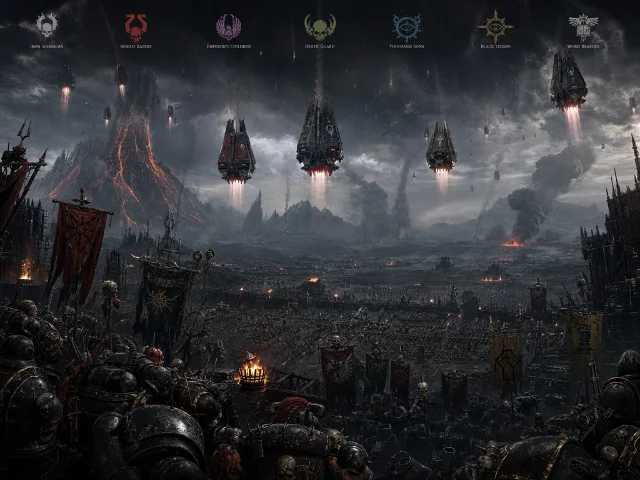
Word reached Terra, and Rogal Dorn — placed in command of the Imperial military by Malcador the Sigillite — dispatched a retribution fleet. He also transmitted an order for seven full Legions to converge on the Isstvan system ahead of his own fleet: the Iron Hands, Salamanders, Raven Guard, Word Bearers, Night Lords, Iron Warriors, and Alpha Legion.4
Dorn did not know that four of those seven had already turned.
Horus had planned this precisely. He fortified the Urgall Plateau on Isstvan V using Dark Mechanicum engineers, building a vast network of trenches, void shields, anti-aircraft batteries, and surface-to-orbit missile silos. The traitor Legions — his own Sons of Horus, the Emperor's Children, the Death Guard, and the World Eaters — waited behind these defences.4
The first three Legions to arrive — the Iron Hands under Ferrus Manus, the Salamanders under Vulkan, and the Raven Guard under Corvus Corax — decided to attack immediately rather than wait for the other four. Ferrus Manus, the Gorgon, was burning with rage at Fulgrim's betrayal and refused to delay. Corax and Vulkan agreed reluctantly, reassured that reinforcements were hours away.4
The first wave descended onto the Urgall Plateau. Sources on the numbers differ: one account gives ten thousand Iron Hands, eighty-three thousand Salamanders, and seventy-nine thousand Raven Guard facing one hundred and fifty thousand traitors. Whatever the precise figure, the three Legions drove deep into the traitor line. Ferrus Manus personally led his elite Morlock Terminators through concentrated fire, the Salamanders pushed back the Death Guard in the Ignis Sector, and Corax's Raven Guard sliced into the traitor flank with jump-pack assaults.4 Three hours in, the loyalists were winning.
Then the second wave arrived.
The Word Bearers, Iron Warriors, Night Lords, and Alpha Legion executed combat landings directly into the already-established loyalist drop zone, landing as supposed reinforcements. The sight of this additional force appeared to drive a general traitor retreat, pulling Angron, Mortarion, and the Imperator Titan Dies Irae back from the fighting line. The battered first-wave legions, low on ammunition, began moving toward what they thought were friendly positions.4
Some Raven Guard got close enough to identify and hail the Word Bearers by name before the firing started.
Horus gave a single order from his command post: "illuminate them."4
The Iron Warriors, Word Bearers, Night Lords, and Alpha Legion opened fire on the Raven Guard and Salamanders from behind. Night Lords gunships materialised overhead, dropping phosphex and cluster bombs onto the trapped loyalists below. Alpha Legion Apothecary stations that had been erected to give aid threw off the disguise and butchered the injured marines they were supposed to treat. The Iron Warriors' artillery batteries opened up on the stunned Imperial Army. The entire first-wave force — already depleted, running low on ammunition, approaching what they believed was safety — found itself caught between the advancing traitor legions from the front and the revealed second wave behind it.4
It was, by every measure, a perfect trap.
The encirclement of loyalist forces at the Urgall Depression 4
The death of Ferrus Manus
Ferrus Manus, in the chaos, saw Fulgrim — his closest friend, the brother he had loved, the Primarch who had spent weeks trying to recruit him before their final ugly meeting ended with the Emperor's Children violently escaping. Ferrus charged him.
What followed was a duel between the two closest brothers in the Primarch hierarchy. Whatever it looked like from the outside, inside it was grief and rage and something that had gone irreversibly wrong. Fulgrim won. He beheaded Ferrus Manus on the black sand of Isstvan V.4
Immediately after the kill, Fulgrim — horrified by what he had done — surrendered to the daemonic possession that had been waiting for him and effectively ceased to exist as an independent entity for a time.
Horus later mounted the skull of Ferrus Manus in his throne room. He would reportedly talk to it privately, lamenting that he had to rely on psychotic generals and daemons instead of real strategists like Ferrus had been.2 Whatever this says about his mental state at that point, it suggests something had not been entirely cauterised: the knowledge of what he had destroyed.
The aftermath and the spreading heresy
When the guns fell silent at Isstvan V, the numbers were staggering. Sources vary considerably, but the Iron Hands lost over ninety-two percent of their strength, the Raven Guard over ninety-four percent, and the Salamanders over ninety-six percent.4 Three full Legions had been effectively destroyed as fighting forces in a single day. The survivors scattered — Corvus Corax escaped with perhaps three thousand Raven Guard after ninety-eight days of hiding on the planet. Vulkan ended up a prisoner aboard Konrad Curze's flagship. Primarch Ferrus Manus was dead.
Following the battle, Horus gathered his nine traitor Primarchs for a council of war. He assigned them their tasks across the galaxy: the Word Bearers to destroy the Ultramarines at Calth, the Night Lords to chase the Dark Angels, the Alpha Legion to operate behind enemy lines. With Guilliman mauled, the Space Wolves reeling from ambush, and the White Scars deployed far away, Horus calculated that a fast push toward Terra would face only Rogal Dorn and the Imperial Fists.4
He was not entirely wrong about the calculation. He was wrong about the timeline.
Fulgrim presented the head of Ferrus Manus to the Warmaster as a trophy. Horus's northern fiefdom — called the Dark Empire — began to take shape. The Sons of Horus had been renamed once already, from Luna Wolves to Sons of Horus; now they wore the green and gold of their fallen master's ascent.2
The galaxy had just split open. What had been one empire was now two sides of a catastrophic civil war, and the man who had made it happen was looking toward Terra.
What he had become
There is a line from the Horus Heresy cinematic records, attributed to Horus in the years after the Heresy was declared open:
"I never wanted this. I never wanted to unleash my Legions. Together we banished the ignorance of Old Night. But you betrayed me. You betrayed us all. You stole power from the gods and lied to your sons... Though it takes the last drop of my blood, I will see the galaxy freed once more."2
This is what the Serpent Lodge had built: a man who genuinely believed he was on the righteous side. The genius of Erebus's manipulation was not that it made Horus evil — it was that it made him certain he was not. Every monstrous act in this period, from Davin's moon through the virus-bombing of twelve billion civilians to the orchestration of the Drop Site Massacre, was committed by a man who had convinced himself that he was the one fighting to save humanity from a tyrant.
Whether that belief was wholly sincere, or whether some part of Horus always knew what he was and chose to continue anyway, is a question the lore has never resolved cleanly. What it does record is that he was good at it. The planning of Isstvan III and V was not the work of a man losing his mind — it was methodical, patient, strategically precise, and devastatingly effective. The Emperor's finest son had turned his genius against the Emperor.
Next episode — Part III: The Siege of Terra — will follow Horus from his ascension at Molech through his confrontation with Leman Russ at Trisolian, the Solar War, the Siege of Terra itself, the death of Sanguinius, and the final duel with the Emperor aboard the Vengeful Spirit.
Previously featured characters: Roboute Guilliman (Parts I–III), Mortarion (Parts I–III).
このコンテンツについて、さらに観点や背景を補足しましょう。