INSPIRED — the book that rewired how product teams think about their jobs
Marty Cagan's INSPIRED in full: the feature-factory diagnosis, the four-risk framework, empowered product teams — plus five decisions you can act on this week.

INSPIRED — the book that rewired how product teams think about their jobs
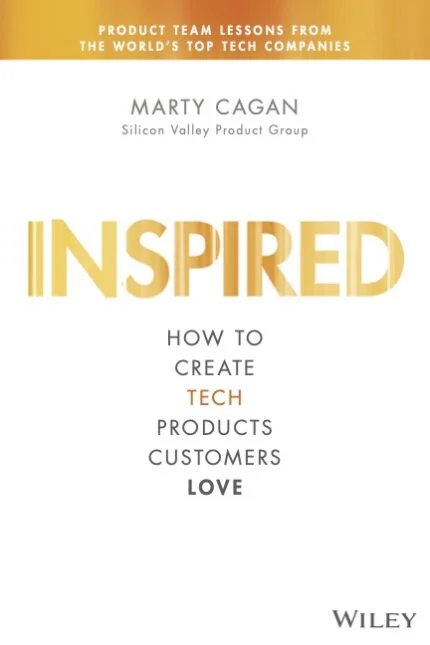
Marty Cagan spent two decades inside the product organizations that shaped the modern software industry — Hewlett-Packard, Netscape, AOL, eBay — before founding the Silicon Valley Product Group (SVPG) in 2001 to share what he had learned. The first edition of INSPIRED: How to Create Tech Products Customers Love came out in 2008. A thoroughly rewritten second edition followed in December 2017, published by Wiley. 1
The numbers suggest it landed: 4.6 out of 5 stars from 6,249 Amazon ratings as of May 2026, the #1 Best Seller in Business Research & Development, and 4.23 across nearly 26,000 Goodreads ratings. 1 SVPG's official description frames it as the natural successor to the first edition — "completely new" in its examples and depth, but anchored to the same core conviction: almost every company that builds software products is doing it wrong. 2
The book runs 368 pages organized into four parts: People, Product, Process, and Culture. That structure is deliberate — Cagan's argument is that bad product outcomes are never primarily a technology problem. They are a people-and-process problem.
Image from SVPG official site
The diagnosis: three ways companies fail before writing a single line of code
Cagan opens the book's argument with a blunt observation: most technology companies are not product companies. They are IT organizations wearing a product company's clothing. The difference is visible in how they treat the roadmap.
In a feature factory — Cagan's term for the dominant failure mode — the roadmap is a prioritized list of features assembled from sales requests, stakeholder opinions, or an executive's conviction about what customers need. Engineers implement the list. A project manager tracks the dates. The PM role is reduced to writing requirements and keeping stakeholders updated. When the features ship and customers don't use them, the organization blames execution.
Cagan identifies three specific patterns that produce this outcome:
- Sales-driven or stakeholder-driven roadmaps — the business decides what to build before anyone has tested whether customers want it
- Technology looking for a problem — engineering builds something technically interesting without validating actual demand
- Product managers as project managers — PMs own the backlog but have no accountability for whether the backlog produces any value
The unifying diagnostic tool Cagan introduces is the four risks that every product idea carries before it reaches customers: value risk (will customers actually want this?), usability risk (can they figure out how to use it?), feasibility risk (can the engineering team build it reliably?), and viability risk (does this work for the business — legally, financially, ethically?). Most organizations address only feasibility and push the rest to post-launch discovery. By then, the cost of being wrong is enormous.
Running parallel to the four-risk framework is the mercenaries vs. missionaries distinction — the most-quoted metaphor in the book. A team of mercenaries ships what they're told. A team of missionaries believes in the problem they're solving and takes personal ownership of outcomes. The difference is not primarily about compensation or talent; it's about whether the people building the product understand why it matters. Honey Krishnan P., a senior PM who listed INSPIRED among her top reads of 2025, summarized the shift: "The core shift is from Mercenaries to Missionaries. By applying the concept of Empowered Teams, you stop managing tasks and start managing outcomes." 3
The prescription: three frameworks that define Cagan's method
Empowered product teams
The building block of Cagan's solution is a specific team structure: a cross-functional triad of a product manager, a product designer, and at least one engineer, accountable for a well-defined problem space rather than a feature list. The PM's job is not to manage the backlog — it is to ensure the team understands the customer problem deeply enough to solve it well.
The word "empowered" does real work here. An empowered team is given a problem to solve (for example, "reduce checkout abandonment by 15%"), not a solution to implement ("add a one-click checkout button"). The team owns discovery — figuring out what to build — as well as delivery. Leadership sets the strategic context; the team decides the best way to achieve it.
This stands in contrast to what Cagan calls the "features and projects" model, where leadership hands teams a prescribed solution and expects delivery on a fixed date. In that model, teams can be perfectly efficient at shipping the wrong thing.
Product discovery and product delivery
The sharpest structural idea in the book is the separation between product discovery and product delivery — and the insistence that they must run concurrently, not sequentially.
Discovery is the work of answering the four-risk questions before significant engineering investment begins: quick prototypes, customer interviews, feasibility spikes, and usability tests. It is measured in hours and days, not quarters. Delivery is the work of building the validated solution reliably at production quality.
The failure mode Cagan is combating is the waterfall assumption that discovery happens once, at the start of a project, and then closes. In the world he describes, discovery is continuous. The team is always running small experiments on future possibilities while the current sprint delivers the previous ones.
The Trainline CTO, writing about the company's transformation between 2014 and 2019, distilled Cagan's cultural principles into a single line: "Principles over process. Trust over control. Innovation over predictability. Learning over failure." 4 Those four pairings are a precise shorthand for what the discovery/delivery model requires of an organization.
The product operating model
The third concept — crystallized more explicitly in Cagan's later book Transformed but rooted in INSPIRED — is the product operating model: the idea that how a company organizes, plans, and holds teams accountable is inseparable from the quality of the products it ships.
A product operating model replaces project-based roadmaps with outcome-based roadmaps: teams commit to measurable results (conversion rate, activation rate, error rate), not to a list of features. The roadmap becomes, as the former Trainline CTO put it, "the handshake with the business. Not a feature list. Not a Gantt chart." 4
Three companies that ran the experiment
The richest evidence for Cagan's frameworks is not in the book itself — it's in what teams built after reading it.
Trainline provides the most detailed documented case. When the former CTO joined the UK rail ticketing platform in 2014, marketing was writing specification documents and handing them to outsourced engineering teams. The company was, in his words, "an old, slow-moving business." 4 Over five years, with Jon Moore (whom Marty Cagan mentored directly) as CPO, the organization restructured into durable cross-functional squads pursuing outcome-based roadmaps. The alignment tool — a spreadsheet called "The WIP Wall" — coordinated 650 people in product and engineering around shared outcomes visible to the board. "We went from marketing writing specs for outsourced engineers to empowered squads pursuing business outcomes. We aligned 650 people around a shared roadmap." 4 Trainline IPO'd on the London Stock Exchange in June 2019, valued at over £1.7 billion. 4
The Palace Company, a family-owned luxury hospitality group with 15,000 employees, reached the same diagnosis from a different industry. CTO Anuar Chapur described the state of the IT department before transformation: "We ended up building things that delivered zero to negative value and had low team morale." 5 An earlier "agile transformation" attempt had made things worse, not better. "It looked like agile, but had a big waterfall behind it. It only looked like agile from afar." 5 After Chapur attended a Marty Cagan workshop, the team identified a pilot squad and gave it a problem to solve instead of a feature to deliver. The real issue, Chapur concluded, "wasn't speed but that the solution didn't work for the client or the business." 5 The pilot team's early success gradually shifted the broader organization's expectations.
Almosafer, a travel platform within Seera Group, ran a more internally focused version of the same shift. Head of Product Ronnie Varghese described inheriting a "classic feature factory — shipping features without impact." 5 His first move was to treat the product organization as a learning environment rather than a delivery machine — what he called "a Montessori for product people." The cultural change preceded and enabled the outcome change: Almosafer reported a 28%+ uplift in conversion as a result of the transformation. 5
Two shorter but notable endorsements: Ann Yauger, AVP of Product at CarMax (the largest used-car retailer in the US), called INSPIRED "a catalyst for helping us transform how we organize and operate," citing "actionable steps and the fundamental truths to keep us on course." 2 Heroku co-founder Adam Wiggins described it as "an invaluable resource" during the company's "challenging 50-to-150 employee phase." 2
Where the book earns its pushback
INSPIRED has a real critical record, and ignoring it would misrepresent what working PMs actually report when they read it.
The most consistent complaint — appearing across Goodreads, LinkedIn, and the Arguing Agile podcast — is that the book describes an ideal state without mapping the path from wherever you actually are. Ed Martin, co-host of the Arguing Agile podcast, summarized it after reviewing Cagan's follow-up Transformed: "He's not giving you a path of how to get there. He's just showing you what the ideal looks like." 6 Martin and his co-host also cited product leaders Paweł Huryn and Akash Gupta: "99 percent of the companies and teams don't work in anything close to the environment Marty envisions." 6
Goodreads reviewer Neil Sharma argued that the title itself makes a promise the content doesn't keep: "The title 'Inspired, how to create tech products customers love,' does not align with the content. This book tells you how to be a product manager and talks nothing about building great products." 7 Reviewer Nguyễn Tuấn docked a star specifically because the book "largely touches on B2C products, and leaves out B2B ones" — a meaningful gap given that most PMs work in business software. 7 Reviewer Peter Gfader flagged a structural tension: the book's sharp separation of discovery and delivery "seems very old thinking," and the assumption that high-fidelity prototypes answer the most important customer question — "will they pay for it?" — does not hold. 7
Software engineer Marcin Sodkiewicz identified a more philosophical objection: Cagan implies that passion for a product is an innate trait, not something that can be developed. "It's almost product manager predeterminism," Sodkiewicz wrote — a framing that sits uneasily in a profession built on coaching and growth. 8
LinkedIn PM Himanshu Sharma gave the clearest summary of what the book does and doesn't offer experienced practitioners: "If I had read this book 5 years ago, it would've blown my mind." For PMs already working in discovery-oriented teams, he added, "much of this might feel… familiar." His recommendation for veterans: "MAYBE — if you've been in the trenches for a while, you might not learn something radically new, but it can still be a grounding and reflective read." 9
The counterweight to all of this is Gonzo Schexnayder's measured summary: "While Cagan's roadmap isn't for every company or everyone, I suggest that the book is. Like any learning opportunity, you take it all in and keep what works for you." 10 Ulad Shauchenka, whose 2025 PM reading list aggregated community recommendations from r/ProductManagement and Hacker News, placed INSPIRED first and called it "still the clearest 'PM 101' for ICs — use it to align on responsibilities, discovery vs. delivery, and teaming with design/engineering." 11
The critiques don't cancel the endorsements. They define the book's actual audience: INSPIRED is a rigorous entry point into a specific philosophy of product management, not a tactical playbook for navigating organizational dysfunction you already know.
Five decisions to run this week
Cagan's frameworks work as diagnostics you can apply immediately. These five actions derive directly from the book's core arguments:
1. Audit your roadmap for outcomes vs. features. Pull up your team's current roadmap. For each item, ask: is this phrased as a desired outcome (metric, user behavior, business result) or as a prescribed feature? A roadmap dominated by feature descriptions is a signal that your team is operating as a feature factory, regardless of what the org chart says.
2. Run one unscripted customer interview. Not a sales call. Not a usability test with a predetermined prototype. Pick one customer who uses the product area you're currently working on, and ask them to walk you through the last time they encountered the problem your team is trying to solve. Let them set the direction. The goal is to hear what you don't already know — which is not achievable with a question list written by stakeholders.
3. Name your team's unaddressed risk. Go through the four risks — value, usability, feasibility, viability — and honestly identify which one your team almost never explicitly tests before committing to a build. Most teams are weakest on value risk (they assume customers want the thing) or viability risk (they don't loop in legal, finance, or operations until it's too late to adjust). Naming it is the first step toward addressing it.
4. Apply the missionary test. In your next team meeting, ask everyone to write a sentence explaining why the product matters to customers beyond the quarterly OKR target. If the answers are vague, inconsistent, or purely business-metric-oriented, your team is operating as mercenaries. The fix starts with spending more time with customers as a team — not just having the PM report back from research.
5. Propose a two-week discovery sprint before your next major feature. Take the next feature on your roadmap that would require more than two sprints of engineering work. Instead of beginning with implementation, propose running two weeks of structured discovery first — three to five customer interviews, a low-fidelity prototype test, and an explicit feasibility conversation with engineering. The output is not a requirements document; it's a set of answered risk questions. Present the results to your stakeholders before any code is written.
Cover image from SVPG — INSPIRED 2nd Edition official page
참고 출처
- 1INSPIRED 2nd Edition — Amazon
- 2SVPG: INSPIRED 2nd Edition
- 3Honey Krishnan P. on LinkedIn
- 4RoadmapOne: The Product Operating Model inside Cagan's Trainline Case Study
- 5Product at Heart: True Change — Case Studies in Product Transformation
- 6Arguing Agile Podcast: AA172 — Review of Transformed by Marty Cagan
- 7Goodreads: INSPIRED — Community Reviews
- 8Marcin Sodkiewicz on Medium: Geek read — Inspired by Marty Cagan
- 9Himanshu Sharma on LinkedIn: Book review — INSPIRED by Marty Cagan
- 10Gonzo Schexnayder on LinkedIn: Review — Marty Cagan's Transformed
- 11Ulad Shauchenka Substack: Top 20 PM Books 2025
이 콘텐츠를 둘러싼 관점이나 맥락을 계속 보강해 보세요.