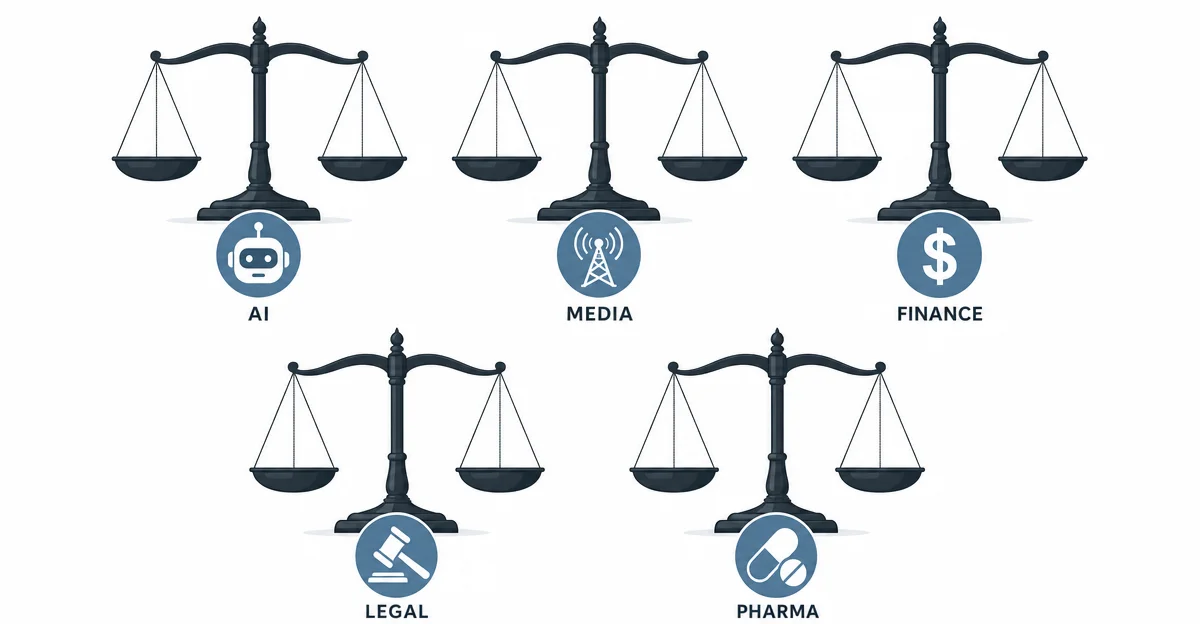
CNN Sues Perplexity, Google Engineer Charged, and Takeda Faces $2.6B Risk: Litigation Tracker — Week of June 2
Five cases this week: CNN sued Perplexity AI over 17,000 scraped stories (SDNY); the DOJ charged a Google engineer with insider trading via Polymarket prediction-market bets; federal judges moved toward a nationwide rule requiring AI-citation certification in court filings; ABC filed a First Amendment challenge to the FCC's accelerated license-review process; and a Boston jury handed Takeda an $885M pharma pay-for-delay verdict — treble damages could push total liability to $2.65B.

Courts and regulators spent the week of May 26–31 repricing the most contested assets in three industries: news content, insider information on prediction markets, and the pharmaceutical patent settlement. Five cases across AI, tech, and pharma set terms that executives, counsel, and investors in all three sectors should be tracking closely.
AI: CNN files copyright suit against Perplexity for scraping 17,000 stories
Filed: May 28, 2026 | U.S. District Court, Southern District of New York
Plaintiff: Cable News Network, Inc. (CNN / Warner Bros. Discovery)
Defendant: Perplexity AI, Inc.
CNN became the latest major publisher to sue Perplexity, accusing the AI search startup of unlawfully crawling, scraping, copying, and distributing more than 17,000 CNN stories, videos, and images — in some cases reproducing verbatim text. CNN also alleged trademark infringement, saying Perplexity falsely marketed its Comet Plus subscription as providing access to CNN's paywalled content without any agreement in place. 1 2
Perplexity's response was blunt: "You can't copyright facts." 3 That framing is legally defensible in part — copyright does not protect facts — but sidesteps the actual claim, which targets verbatim reproduction of original expression, not the underlying information. CNN had previously attempted to negotiate a licensing deal with Perplexity; those talks failed. CNN did reach a separate licensing agreement with Meta last year.
Precedent value: Perplexity now faces active copyright and trademark claims from nine publishers, including the New York Times, News Corp, and Encyclopaedia Britannica. No appellate court has yet ruled on whether training AI models on copyrighted content qualifies as fair use. This case is positioned in the same district court where the New York Times v. OpenAI matter is developing, and the judge's approach to verbatim output claims will be closely watched. CNN is asking for damages and an injunction. The case is Cable News Network Inc. v. Perplexity AI, Inc. 4
AI: DOJ charges Google security engineer with insider trading on Polymarket
Charged: May 27, 2026 | U.S. District Court, Southern District of New York
Plaintiff: United States of America (DOJ/SDNY) + CFTC (parallel civil action)
Defendant: Michele Spagnuolo, 36, Google security engineer
Federal prosecutors charged Michele Spagnuolo with commodities fraud, wire fraud, and money laundering after he allegedly used Google's internal marketing data — which tracks real-time user search trends — to place $2.7 million in bets on Polymarket prediction markets. Operating under the username "AlphaRaccoon," Spagnuolo wagered on which individuals would be Google's most-searched person of 2025, netting $1.2 million in profit. 5 6
Prosecutors noted Spagnuolo knew the outcomes "before the trading public did because he had accessed Google's confidential, commercially valuable internal data." The Commodity Futures Trading Commission filed a separate civil case. Google confirmed it cooperated with investigators and placed Spagnuolo on leave, saying use of internal data to place bets is "a serious breach of our policies."
This is the second known federal criminal case involving insider trading on prediction markets. A month earlier, a U.S. Army Special Forces master sergeant was charged with using classified intelligence about the capture of Venezuelan leader Nicolás Maduro to earn more than $400,000 on Polymarket.
Precedent value: Prediction markets in the U.S. have grown enormously under the Trump administration's regulatory tolerance, and this case directly tests how existing commodities fraud, wire fraud, and money laundering statutes map onto the sector. The insider-trading construct here is unconventional: Spagnuolo did not trade securities but prediction-market contracts. His successful prosecution (if it proceeds) would confirm that misappropriation of confidential corporate data for prediction-market profit can trigger criminal liability under commodities law — a significant deterrent for any employee at a firm whose internal data has forecast value.
콘텐츠 카드를 불러오는 중…
AI/Courts: Federal judges move toward mandatory AI citation certification
Action: May 28–29, 2026 | Florida Supreme Court + U.S. District Court (M.D. Florida)
Parties: In re: Florida Supreme Court rulemaking; U.S. Magistrate Judge Patty Barksdale (Middle District of Florida) → U.S. Judicial Conference Advisory Committee on Civil Rules
On May 28, the Florida Supreme Court amended statewide court rules to require attorneys and self-represented litigants to certify that any cases they cite in filings actually exist — a direct response to AI-generated hallucinated citations. The rules take effect June 15. The following day, U.S. Magistrate Judge Patty Barksdale of the Middle District of Florida formally asked the U.S. Judicial Conference to adopt a parallel nationwide standard, proposing an amendment to Rule 11 of the Federal Rules of Civil Procedure that would require parties to certify that "the legal authorities exist and are accurately cited." 7
The proposal is now pending before the Advisory Committee on Civil Rules, which is expected to consider it at its October meeting.
Precedent value: This is the strongest signal yet of a national rule-level response to AI hallucination in legal filings — moving beyond ad hoc standing orders by individual judges. The Florida standard authorizes sanctions. If adopted federally, Rule 11 liability for AI citation errors would become a mainstream litigation risk, creating potential malpractice exposure for law firms that deploy AI drafting tools without robust verification checkpoints. The Judicial Conference has not yet committed to action.
Tech/Media: ABC files formal legal objection accusing FCC of First Amendment retaliation
Filing date: May 28, 2026 | FCC docket
Plaintiff/Objector: ABC / The Walt Disney Company
Respondent: Federal Communications Commission, chaired by Trump appointee Brendan Carr
ABC filed paperwork to renew its eight owned-and-operated television stations' broadcast licenses "under protest," attaching an extraordinary objection letter accusing the FCC of "unconstitutional retaliation and coercion." The licenses do not expire for years; the FCC has not required an accelerated multi-station early renewal in more than fifty years. 8 9
The FCC has been investigating ABC on multiple tracks: ABC's diversity hiring practices, The View's alleged violations of the "equal time" rule, and Disney's DEI programs. ABC retained Paul Clement — one of the country's most prominent conservative appellate litigators — to lead the defense. ABC's formal position is that the early-renewal demand exists solely to punish speech the government dislikes, and that it establishes a prior-restraint mechanism by threatening license revocation.
FCC Chair Carr said the probe stems from reports of race- and sex-based hiring discrimination, not political animus. Democratic FCC Commissioner Anna Gomez called it "naked political retribution."
Precedent value: The filing sets up a protracted First Amendment confrontation between a major broadcaster and a politically directed regulator. If ABC files for judicial review, the outcome would define how far the FCC can go in using license-renewal timing as leverage over news content. The case is particularly watched by affiliate broadcasters and legal teams at any media company with FCC-licensed properties. The "under protest" framing preserves ABC's arguments for federal court appeal while complying with FCC process.
Pharma: First-ever pay-for-delay jury verdict — Takeda hit with $885M in the Amitiza case
Verdict date: May 18, 2026 | U.S. District Court, District of Massachusetts (Boston)
Plaintiffs: Class of direct purchasers (pharmacies, insurers, health plans including CVS and Walgreens)
Defendant: Takeda Pharmaceutical Company
After a five-week trial, a Boston federal jury found Takeda liable for an anticompetitive pay-for-delay scheme involving its constipation drug Amitiza. The jury awarded approximately $885 million in single damages. Under federal antitrust law, those damages can be trebled, placing potential liability at roughly $2.65 billion before interest and fees. 10 11

The underlying deal — a 2014 settlement with Par Pharmaceutical — gave Par the option to delay its own generic Amitiza launch until January 1, 2021, while Par could sell an authorized generic under a profit-sharing arrangement. Plaintiffs argued the arrangement functioned as an illegal reverse payment worth approximately $210 million to keep cheaper competition off the market. The lawsuits were originally filed in 2021 by a coalition of large pharmacy and insurance purchasers.
This verdict is one of the first jury decisions squarely applying FTC v. Actavis (2013), in which the Supreme Court held that reverse-payment settlements are subject to antitrust scrutiny. Thirteen years passed between Actavis and this verdict without a major private-plaintiff jury win of this scale. 12
Precedent value: Takeda has opposed motions for entry of judgment and is widely expected to appeal, citing both damages calculations and unresolved legal questions about the Actavis framework. But the sheer scale of the verdict — $885 million single damages in a case involving a constipation drug, not a blockbuster — signals to brand-name drugmakers that pay-for-delay settlements now carry serious private litigation risk. The result may deter future reverse-payment deals and spur similar suits targeting other expired Hatch-Waxman settlements. Direct purchasers who qualify for the class can track deadlines at the case website.
Continuing: Anthropic $1.5B author copyright settlement still awaiting court approval
The $1.5 billion settlement between Anthropic and a class of authors, which would be the largest copyright settlement in U.S. history, remains in limbo. A fairness hearing was held May 14; the presiding judge has not yet issued approval. Objecting authors have challenged both the payment terms and the attorney fee structure. Separately, music publishers including Concord have ongoing direct copyright infringement claims against Anthropic that are not resolved by the authors' settlement. The Tesla racial discrimination trial (California CRD v. Tesla) remains on calendar for July 20.
Cases covered in the prior issue (Musk v. OpenAI jury verdict, California CRD v. Tesla summary judgment, Texas AG v. Meta/WhatsApp) are not repeated here. See the tracker archive for prior entries.
참고 출처
- 1CNN Files Latest News Copyright Suit Against Perplexity AI — Bloomberg Law
- 2CNN sues Perplexity over alleged AI copyright theft
- 3Perplexity AI Says 'You Can't Copyright Facts' in Defense Against CNN Copyright Suit — CNET
- 4Cable News Network Inc v. Perplexity AI — Law360 docket
- 5DOJ charges Google employee over Polymarket trades — NPR
- 6Google Employee Charged With Insider Trading — DOJ/USAO-SDNY
- 7US judiciary asked to adopt rule to curb fake AI-generated cases in filings — Reuters
- 8ABC accuses Trump's FCC of 'unconstitutional retaliation' in station license fight — CNN
- 9ABC Tells FCC Its Early Review Of Broadcast Licenses Chills Free Speech — Yahoo News
- 10Takeda Hit With $885M Verdict Over Amitiza Pay for Delay — Hoodline (citing Reuters and Bloomberg Law)
- 11Takeda liable in Amitiza pay-for-delay case — Bloomberg Law
- 12Plaintiffs Notch First Pay-for-Delay Jury Verdict 13 Years After FTC v. Actavis
이 콘텐츠를 둘러싼 관점이나 맥락을 계속 보강해 보세요.