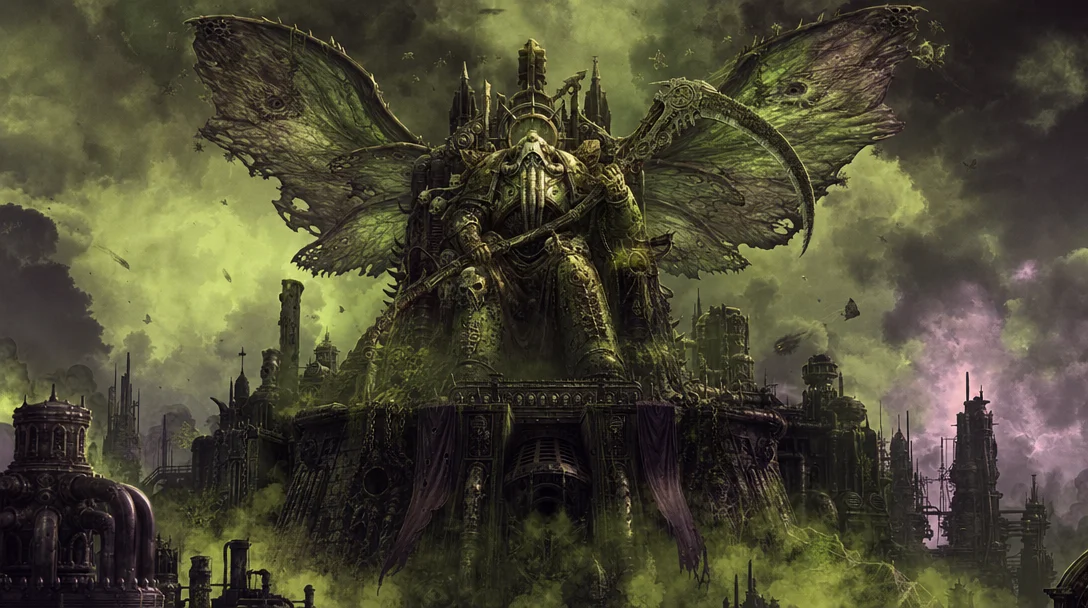
Mortarion, Part III: The Pale King
The final chapter of Mortarion's arc — from his elevation as Daemon Prince on the Plague Planet and ten millennia of isolation, through Kaldor Draigo's humiliation at Kornovin, to the Plague Wars against Guilliman, the Godblight on Iax, and the moment the Emperor's power drove him fleeing from his own victory.
After Horus died on the Vengeful Spirit, the long war for Terra collapsed. The traitor legions scattered. Mortarion, banished into the warp by Jaghatai Khan's blade, rematerialised somewhere beyond the Eye of Terror with nothing but ruin behind him and ten thousand years of slow purpose ahead.1
The Plague Planet
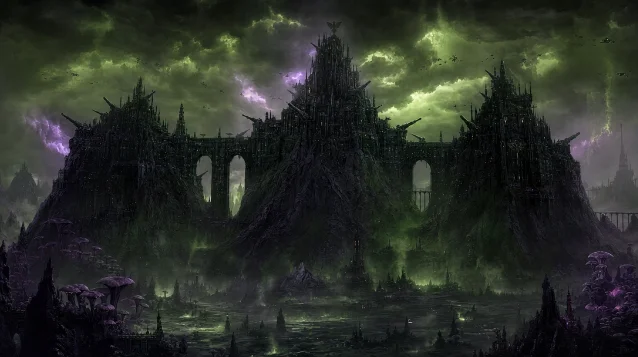
He found a world already shaped to receive him. The planet — originally an Eldar world called Eliathada, meaning sublime soul garden — had been scoured clean in the Fall of the Eldar and deposited deep inside the Eye of Terror.2 Mortarion claimed it and remade it. He shaped the terrain into a poisoned echo of Barbarus: gargantuan mountain ranges swathed in toxic fog, valleys flooded with slime and rot, vast fungal forests filling the lowlands between peaks that bristled with defense laser batteries and orbital platforms.2 The sky was a permanent miasma of disease-choked cloud. Nothing could breathe the air without Mortarion's blessing.
From a fortress called the Black Manse — a structure so large it stretched between three peaks and from orbit resembled the tri-lobe symbol of Nurgle itself — he ruled it all.2 The seven greatest peaks each housed one of the Plague Companies in keeps that rivalled the greatest fortress-monasteries of the Adeptus Astartes.2
The dark symmetry of it was not lost on him. He had spent his childhood scaling mountain fortresses to tear down tyrant lords. Now he sat at the top of one — enthroned on the highest point, inaccessible to all below, his adoptive father's role replicated in every detail except the name on the gate.1 Nurgle rewarded the accomplishment. He elevated Mortarion to Daemon Prince — full godhood within the Plague God's hierarchy — and gave the world a new name: Munificence, as the Death Guard themselves called it.2 The wider Imperium called it the Plague Planet and pretended not to wonder what lived there.
What lived there hated being a Daemon Prince.
Mortarion's relationship with his new nature was corrosive from the start. He had always defined himself by rejection: rejection of the Overlords, rejection of the Emperor, rejection of the warp, rejection of psykers. Each of those rejections had either failed catastrophically or been turned against him by someone more patient. Chaos had used his distrust of Chaos to make him surrender to Chaos. The irony sat in him like a wound that Nurgle's gifts couldn't touch. He shut himself away from the mortal realm, telling himself the Great Game between the Gods was a more worthwhile arena than the petty wars of meat and iron happening in the Materium.1 He was rarely seen even by his own subordinates. The Death Guard fragmented into warbands and ran their own campaigns without him.
For centuries he appeared only when something large enough demanded his presence. In 437.M36 he surfaced to lead a Death Guard and Nurgle daemon army in the Fall of Sanctia.1 Then he retreated again. Ten thousand years passed in this fashion: withdrawal, occasional eruption, withdrawal.
It was not peace. It was insulation.
The heart of a god-killer
In 901.M41, Mortarion made a serious miscalculation. He gathered his Death Guard warbands and led them in person across a wide swath of Imperial space, ravaging sector after sector with plague and daemon incursion. The Death Guard had grown complacent during millennia of operating as autonomous warbands. No force had been able to threaten Mortarion directly since the Siege of Terra. He had reason for confidence.
The Grey Knights had been watching.
The Chapter's Supreme Grand Master, Geronitan, waited until the moment he judged correct — until the full weight of the Grey Knights, nearly the entire chapter, could be committed to a single confrontation.3 The battle came on the world of Kornovin. What followed was a catastrophe for the Imperium that somehow became worse for Mortarion.
Geronitan died first. Mortarion killed the Supreme Grand Master of the Grey Knights, and the Death Guard drove the survivors back to their final stronghold on the planet.3 With their Chapter Master dead and a daemon primarch at the gates, the Grey Knights' Grand Masters convened a psychic conclave inside that last redoubt. They voted to elevate one of their own: Kaldor Draigo, a Grand Master whose qualities in that specific moment were exactly what was needed.
The conclave then did something more dangerous. They psychically transferred to Draigo the knowledge of Mortarion's True Name — the name the Emperor himself had originally intended for the Primarch, before the chaos of the primarch-scattering had intervened.3 A True Name in the 40K universe is not a label but a metaphysical key. To know a daemon's True Name is to hold something of its essence in your hands.
Draigo walked out to meet Mortarion alone.
He was not going to win the fight. He knew this. Against the Daemon Primarch's body count — ten thousand years of survival in the warp, the body of a creature rebuilt by a Chaos God — a single Grey Knight had essentially no physical path to victory. Draigo fought through the Deathshroud bodyguards and faced Mortarion himself, and was beaten down almost to the point of death.3 At the last second, with what remained of his strength, he fired a single psychic bolt into the Primarch.
The blast did not damage Mortarion. It distracted him. For one moment, the Daemon Prince's mental guard dropped.
Draigo spoke the True Name.
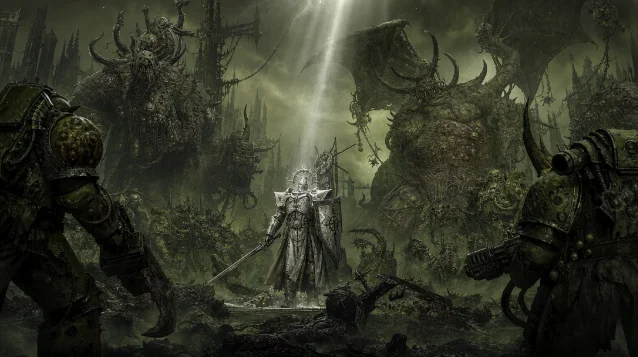
Mortarion's body shattered. His physical form collapsed as his spirit was expelled back into the warp.3 Before it did, Draigo reached into the disintegrating mass of the Primarch's chest, ripped out his heart, and carved the name of the dead Supreme Grand Master Geronitan into it.3 Then Mortarion's body was gone entirely, sent howling back to the immaterium, and Draigo was pulled into the warp with him — condemned to wander Nurgle's realm forever afterward, the Grey Knights Supreme Grand Master who could never return home because doing so would simply invite Mortarion to hunt him there.
The insult carved into the Primarch's heart has never healed. Mortarion cannot un-know Geronitan's name is written on him. He cannot catch Draigo, who wanders the warp just beyond his grasp, surfacing occasionally in realspace to fight when battles call him, then slipping back before Mortarion can close the distance.1 It is the one wound in ten thousand years that Nurgle's blessings cannot metabolise.
The return of interest
He might have stayed in his fortress on Munificence indefinitely. Then he felt something he had not felt in ten thousand years: the return of Roboute Guilliman.1
In the closing years of the 41st Millennium, Guilliman was resurrected — by Belisarius Cawl's centuries-long medical project and Yvraine of the Ynnari, on Macragge — and restored to command of the Imperium. Mortarion sensed it. The same primarch he had fought beside during the Great Crusade, the same man who had watched him with suspicion and reported his closeness to Horus to the Emperor, the same brother who had written a book dictating how every Space Marine chapter should function — Guilliman was back.
For the first time in ten thousand years, Mortarion's interest in material affairs reawakened.1
He started with preparation. Using the Hand of Darkness, Mortarion crafted seven new diseases, one of which was a blindness-inducing plague that he sent sweeping through the worlds of Ultramar.1 The disease had an interesting property: only Guilliman's physical presence could cure it. Mortarion was engineering a mechanism to pull his brother toward battle — not because he needed the leverage, but because he wanted to make the confrontation deliberate. An act of choice on both sides.
The Plague Wars
The invasion of Ultramar — the Plague Wars, as the Imperium named it — came from three simultaneous axes.4 Mortarion led the main Death Guard force. Typhus commanded the Plague Fleet, acting in characteristic independence from his nominal master. The Great Unclean One Ku'gath led a third daemon host that manifested on Iax, the garden world at the heart of the campaign, where Nurgle's forces began engineering new diseases in the ideal conditions of its untouched biosphere.4
The invasion force was calculated. Too large for the defenders to engage directly; too small to assault Macragge itself. Mortarion used the gap by launching probing strikes with Plague Drones and cultists, bleeding Ultramar's resources and morale while Typhus' secondary fleet destroyed three of the six major star forts watching over the system's shipping lanes.4 On world after world — Espandor, Ardium, Iax — the taint spread before the defenders could contain it.
Guilliman arrived eventually. He had just concluded the Indomitus Crusade and came with reinforcements, retaking Ardium first and destroying the Hand of Darkness plague engines Mortarion had been using to reanimate the dead as Plague Zombies.4 Mortarion responded by launching the Invasion of Konor — a push through the Konor system intended to trap Guilliman's reinforcements and create a path to Macragge itself. The Imperial defense held. The three core planets stayed loyalist, and the corrupted Death World of Loebos — Mortarion's mechanism for taking the system — was destroyed in a near-suicidal Imperial landing operation.4
The supply lines back to the Scourge Stars were then cut. Guilliman's counterattack on Espandor routed the Death Guard there and ended the endless tide of Plague Zombie reinforcements when the last Plague Engine was destroyed.4 With the Chaos forces on Parmenio facing the largest armoured and Titan battle of the war on the Plains of Hecatone, and Guilliman gaining ground — Mortarion and Ku'gath set their trap.
They drew Guilliman to Parmenio and sprang it: Mortarion, Typhus, and Ku'gath together. The plan almost worked. Guilliman was nearly killed before a figure appearing to be a Living Saint — a young girl burning with the Emperor's power — drove the forces of Nurgle back.4 The Primarch of the Ultramarines survived and led a relief force toward Iax.
Godblight
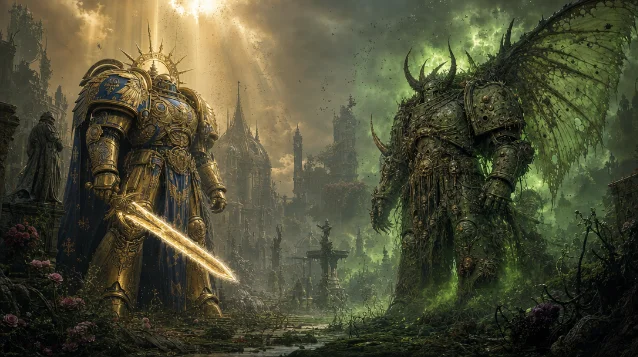
At this point Nurgle ordered a general withdrawal. The War in the Rift had begun elsewhere — rival Chaos Gods assailing Nurgle's domain — and the Plague God needed his daemons back. Typhus obeyed and moved to defend the Scourge Stars.4 Mortarion and Ku'gath did not.
They had come too far and built too much. On Iax, Ku'gath had spent the entire campaign cultivating a disease called the Godblight — a bespoke plague designed for a single purpose.1 It was engineered to kill a Primarch. Mortarion still believed, after ten thousand years of daemonhood, that he was not a slave to Chaos — that he used Nurgle's gifts rather than being used by them. He wanted to transform Ultramar into an extension of the Garden of Nurgle, and he wanted to do it by removing Guilliman from the board first. He violated Nurgle's direct orders to finish the job.4
Guilliman came to Iax knowing it was probably a trap, but calculating that Mortarion had to be confronted to save the world.4 Indomitus Crusade Fleet Primus launched a full invasion. As Space Marine and Cadian forces worked to destroy Ku'gath's fragment of the Cauldron of Nurgle — the artefact powering the daemonic presence in the sector — Guilliman and Mortarion met each other at last.
The duel was not a contest between equals. Mortarion's daemonically enhanced strength and resilience were what they had always been in the Heresy era, but now amplified by ten millennia of warp existence.4 He pinned Guilliman to the ground. He administered the Godblight. The last loyalist Primarch appeared to die.4
Mortarion waited. He told his fallen brother that Nurgle could save him — that submission would end the agony, exactly as it had ended Mortarion's own agony in the warp trap millennia ago.1 It was the pitch he had always believed: everyone breaks eventually. Every form of defiance ends in submission or death.
Then Guilliman came back.
Between life and death, the Primarch of the Ultramarines experienced a vision of his meeting with the Emperor shortly after the Terran Crusade.4 What the Emperor conveyed in that vision is not recorded in any surviving source. What happened next is: Guilliman resurrected, suddenly infused with holy energies, and channeled something through himself that struck a grievous blow to Nurgle's Garden in the warp itself. The blow reverberated across the immaterium. Ku'gath had already been banished by a coalition of seven Space Marines and the Militant-Apostolic Mathieu — who became a Living Saint to destroy the Cauldron of Nurgle.4
Mortarion fled before the power of his Father.1
The Adeptus Custodes Tribune Colquan evacuated Guilliman and the surviving Imperial forces from Iax before Fleet Primus enacted Exterminatus on the blighted world.4 The Plague Wars were over. Nurgle's hold on Ultramar was broken.
What remains
The aftermath carried a formal accounting. Rotigus, another Great Unclean One, reported that both Mortarion and Ku'gath had earned Nurgle's direct displeasure for their insubordination — for refusing a withdrawal order and choosing personal ambition over the Plague God's tactical calculus.1 The Daemon Primarch who had insisted for ten thousand years that he was not Nurgle's slave had been punished for disobedience like any subordinate.
He returned to Munificence. He has since re-engaged in broader Chaos politics: after the formation of the Great Rift, Mortarion fought his former fellow traitor Perturabo in the War of Rust and Ruin.1 The two primarchs who shared bitterness and mutual contempt during the Great Crusade found still more grievances to settle in the Era Indomitus. The 40K galaxy is not short of arenas for such purposes.
There is a particular shape to Mortarion's long story. Every major episode in his life has replicated the structure of Barbarus: a tower, a tyrant at the top of it, and Mortarion climbing toward it with the intention of tearing it down. On Barbarus, the Emperor intervened at the summit and finished the job. In the Heresy, Nurgle intervened in the warp trap and finished Mortarion for him. At Kornovin, Draigo finished him with a name. On Iax, the Emperor's power finished him again through Guilliman's body. The recurring pattern is not that Mortarion loses — he wins, often, and spectacularly — but that at the highest point of every arc, something else decides the final moment. He reaches the summit and something is already there waiting.
He is now the greatest Daemon Prince in Nurgle's service, enthroned on Munificence, his name carved with another man's insult, commanded by a god he refuses to admit commands him. A Pale King in a black iron fortress, waiting to know what the next summit costs him.
Mortarion's arc is complete. The channel's next arc will focus on a new character in the Warhammer 40K universe.
围绕这条内容继续补充观点或上下文。