www.thebehavioralscientist.com
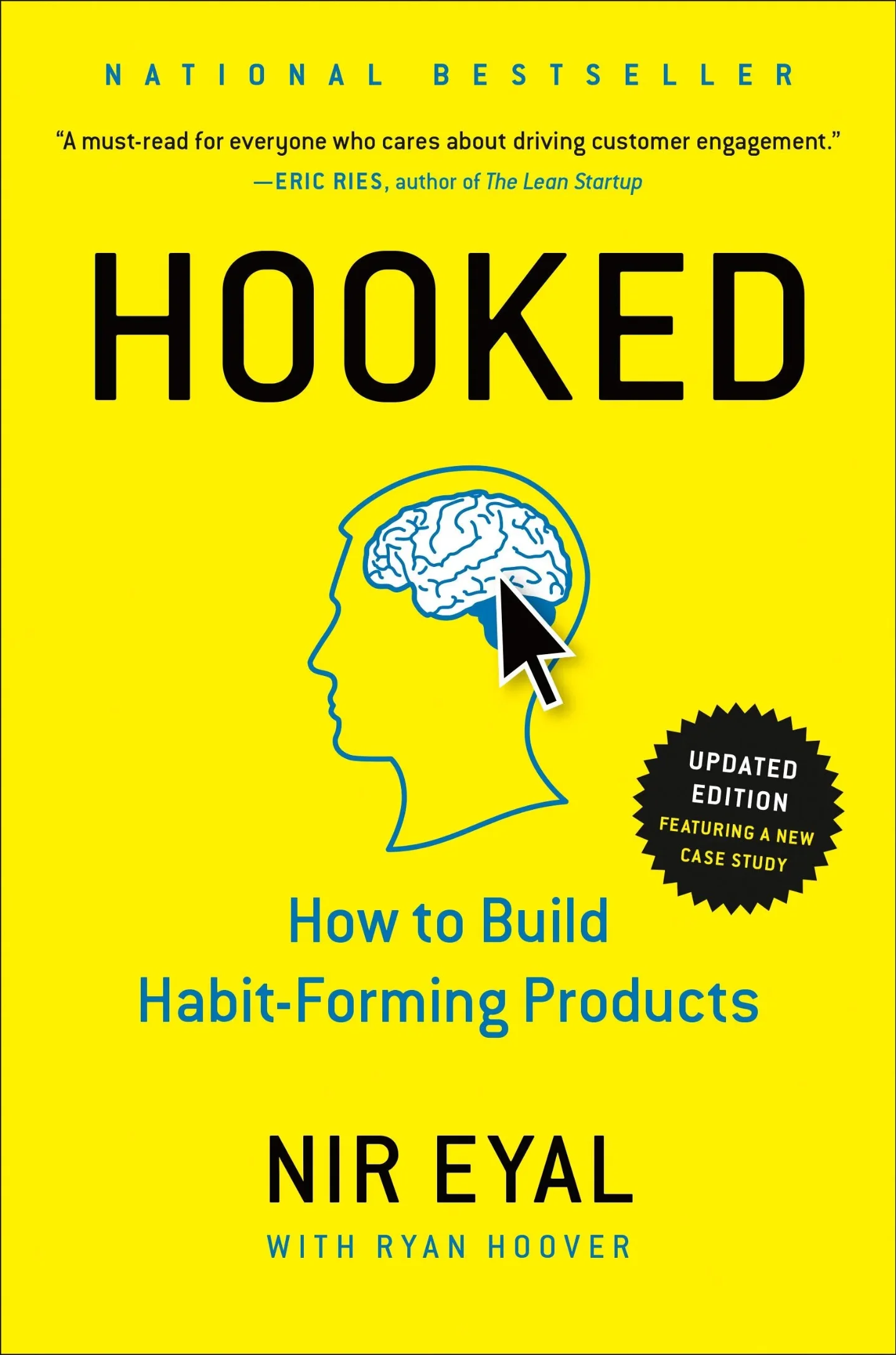
Hooked — the PM book that taught a generation to build habits, and left out the safety instructions
Nir Eyal's Hooked dissected in full: the four-stage Hook Model mechanics, three case studies (Bible App, Meerkat, Duolingo), the strongest critics' case against it, how it relates to INSPIRED and other PM classics, and five habit-audit experiments you can run this week.

Hooked — the PM book that taught a generation to build habits, and left out the safety instructions
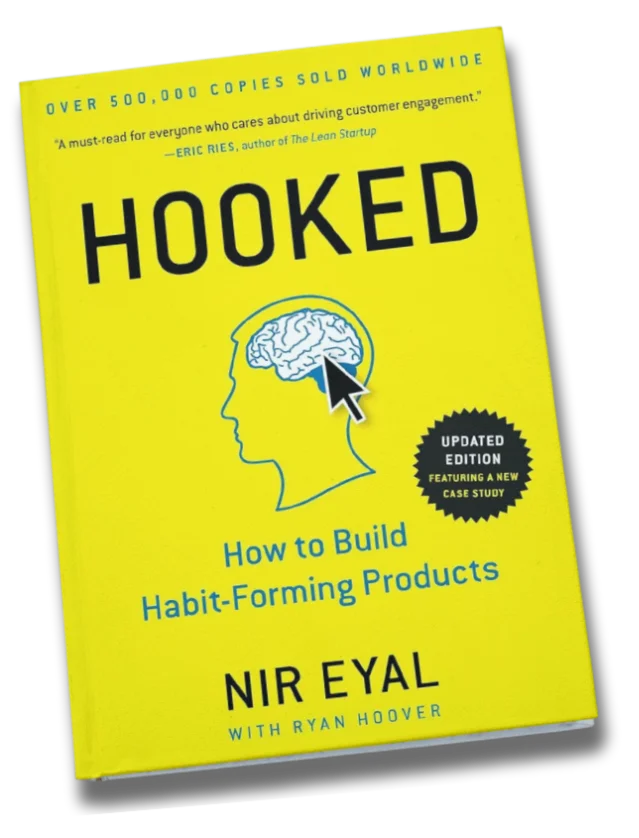
Nir Eyal taught at Stanford's Graduate School of Business and its design school (d.school) before writing this book. 1 He had sold two tech companies and spent years inside video games and online advertising — industries that had already quietly figured out how to get people to come back every day. Hooked: How to Build Habit-Forming Products codified what those industries knew into a four-step framework any PM could apply. 2
The book was published in hardcover on November 4, 2014 by Portfolio/Penguin and has sold over one million copies in more than 30 languages. 2 As of May 2026, it carries a 4.12-star average across more than 50,000 Goodreads ratings. 3 Ryan Hoover — who would go on to found Product Hunt — contributed as editor and has said that he "learned way more than I contributed." 4
Eyal published Indistractable in 2019, essentially teaching users how to resist the systems his first book taught companies to build. His third book, Beyond Belief, came out in May 2026 and landed on the New York Times bestseller list — a sign that Eyal's intellectual project keeps evolving past the habit-formation framework that made him famous. 5
The question for working PMs is not whether Hooked is still relevant — it clearly is, it is being tooled into Claude Skills and taught in MBA programs right now. 6 The question is whether to read it as a technical manual or as a moral puzzle. Both readings are necessary — and the book doesn't fully prepare you for the second one.
The Hook Model: four steps, and why each one actually works
Eyal structures the entire book around a single loop: Trigger → Action → Variable Reward → Investment. What distinguishes Hooked from other behavior-design writing is that it goes one level deeper than "here's what to do" — it explains the psychological mechanism behind each step.
Trigger is the starting gun. External triggers are the notifications, emails, and app badges that prompt the user to act. Internal triggers are what you want to get to eventually: the emotion or itch that makes a user open your product before any external prompt fires. Boredom, loneliness, anxiety, FOMO. 7 The mechanism here is emotional association: each time a user reaches for your product in response to an internal state, the neural pathway linking that feeling to your app gets a little stronger.
Action is the simplest behavior the user can perform in anticipation of a reward. Eyal borrows directly from BJ Fogg (Stanford Persuasive Technology Lab founder), whose Behavior Model says a behavior happens when motivation, ability, and a prompt converge at the same moment. 8 The mechanism: reducing friction is more effective than raising motivation. When the behavior path is this easy — one tap, one swipe — even low-motivation users comply.
Variable Reward is where most PMs underestimate the science. Eyal divides rewards into three types: Rewards of the Tribe (social validation — likes, matches, replies), Rewards of the Hunt (information discovery — feeds, search results, recommendations), and Rewards of the Self (completion — streaks, progress bars, achievement unlocks). 7 The variable part is doing the neurological heavy lifting: the brain's dopamine response to unpredictable rewards is stronger than to predictable ones — the nucleus accumbens fires harder in anticipation of a reward than when the reward actually arrives. This is why a feed that might contain something interesting is more compelling than one that definitely contains what you asked for.
"Without variability, we are like children in that once we figure out what will happen next, we become less excited by the experience," Eyal writes in the book. 9 Zynga's collapse illustrates this precisely: FarmVille peaked at 83.8 million monthly active users, then Zynga re-skinned the same formula as CityVille, FrontierVille, and ChefVille. Players recognized the pattern. By November 2012, Zynga's stock had dropped more than 80 percent from its peak earlier that year — the mechanism had been made predictable. 9 World of Warcraft maintained 10 million active users eight years after launch because other players — not scripted content — created the unpredictability.
Investment is Eyal's most original contribution to the habit-formation literature. After the user gets a reward, they put something back into the system: a post, a profile update, a list of favorites, a follow, a skill tree. This step does two things simultaneously. First, it loads the next trigger — a comment becomes a notification which becomes another open. Second, it creates what Eyal calls "stored value": the personalized data, social connections, and accumulated content that make the product better every time you use it, and that you lose if you leave. 7
Run the loop often enough and you get what Eyal calls the vitamin-to-painkiller transition: the product shifts from something nice to have into something that relieves a discomfort the user now feels without it. The product created the need it then satisfies. That structure is the book's most contested claim — and it's addressed directly in the critique section below.
Three case studies from teams that ran the model
Bible App (YouVersion / Life.Church) is the book's most detailed case study, written by Eyal for Stanford GSB. Bobby Gruenewald, the CEO, built one of the first App Store applications in 2008. By April 2014, the app had over 138 million device installs — a new install every 1.3 seconds — and 475,200 users opening it every hour. 10 More than 200,000 pieces of content were shared from the app to social media daily. 10
The Hook loop is visible in every layer. Trigger: daily push notifications and a badge count, but also pastors prompting congregations to open YouVersion during services ("take out your Bibles or YouVersion app — and we see a huge spike," Eyal noted 10). Action: two taps to start a daily reading plan. Variable Reward: 400+ reading plans meant every user had a different daily verse. Investment: highlights, notes, bookmarks, and social shares that made each user's Bible feel personal. In one celebrated test, Gruenewald's team sent a "Merry Christmas" push notification fully expecting complaints — users instead shared screenshots of it on social media, describing it as God reaching out to them personally. 10
Meerkat is the rarer story: a product whose CEO explicitly built it on the Hook Model and whose failure illuminates a structural weakness in the framework. On the day Meerkat launched in 2015, CEO Ben Rubin emailed Eyal directly: "We pasted up images of the hooked model all over the office and built the product using the model." 11 The live-streaming app exploded at SXSW 2015 — the Trigger (Twitter notifications of live broadcasts) and Variable Reward (seeing real people tune in as you broadcast) were strong. But the Investment step was thin: broadcast content didn't persist, user profiles accumulated nothing, and switching costs stayed near zero. Twitter launched Periscope and Facebook launched Live within months. Meerkat shut down in 2016. The model had been implemented with two strong steps and one missing one — and the one it missed was the only step that creates lock-in.
Duolingo is what Yu-kai Chou (Octalysis gamification framework creator, consultant for LEGO, Microsoft, and Porsche) calls "the Hook Model done closer to right." 12 The mechanics are standard: a 7 PM streak notification (Trigger), a two-minute lesson (Action), XP and leaderboard movement (Variable Reward), streak length and skill tree progress (Investment). What Duolingo adds on top is genuine achievement — users leave sessions having learned something that works in the real world. Chou argues this is what separates hook-based products that leave users feeling drained from those that leave them feeling capable. Duolingo's daily active users reached 37.2 million in Q3 2024, up 54 percent year over year. 12
Where the critics have a point
The most substantive structural critique comes from Jason Hreha, a former member of BJ Fogg's Stanford Behavior Design lab. Hreha argues that the Hook Model is "a slightly revised version of Charles Duhigg's Habit Loop" — Cue becomes Trigger, Routine becomes Action, and Reward stays Reward. 13 He contends that the two genuinely new elements Eyal added — Variable Reward and Investment — actually weaken the model's accuracy: continuous reward schedules, not variable ones, are what habit research shows produces the strongest behavioral loops.
正在加载链接预览…
Yu-kai Chou's critique is more systematic. After mapping all four Hook Model steps to his Octalysis Core Drives, Chou found that the dominant motivational forces in the loop are Black Hat: Core Drive 7 (unpredictability/curiosity) in Variable Reward, Core Drive 8 (loss aversion) in both the vitamin-to-painkiller transition and streak mechanics, and Core Drive 4 (ownership) in Investment. Black Hat drives are powerful — they create urgency and compulsion — but they generate engagement that leaves users feeling anxious or depleted rather than genuinely satisfied. 12
"The Hook Model is morally neutral," Chou writes. "What you put in it is not." 12 The problem is that the framework doesn't tell you what to put in it — and when designers follow the path of least resistance, they default to Black Hat mechanics precisely because those produce faster short-term engagement numbers.
Eyal does include an ethics chapter, organized around a Manipulation Matrix — a 2×2 grid with two questions: "Will I use this product myself?" and "Will it materially improve users' lives?" Products that score yes on both are Facilitators; those that score no on both are Dealers. 14 The matrix is a starting point, but Chou's objection holds: a Facilitator product can still be built almost entirely on Black Hat motivation. The matrix checks designer intent; it does not audit the motivational architecture of the product itself.
The field has noticed. In September 2025, a UX practitioner with 15 years of experience posted on r/UXDesign (237,000 members), saying they had taught Hook Model as best practice and were now publicly questioning whether the industry had "normalized addictive systems." The highest-rated reply, from a veteran commenter, called it bluntly: "Following the habit trend is the worst mistake of our profession." 15
正在加载链接预览…
None of this makes the framework wrong. It makes it incomplete.

How Hooked sits inside the PM canon
Hooked doesn't compete with the other PM classics — it fills a gap none of them address. Here's where each one ends and Hooked picks up:
| Book | What it covers | How it relates to Hooked |
|---|---|---|
| INSPIRED (Cagan) | Empowered teams, four risks, discovery vs. delivery | Sets the discovery process; Hooked tells you what to discover about user behavior — specifically, whether a habit opportunity exists and how to engineer it |
| Don't Make Me Think (Krug) | Usability, reducing cognitive load | Addresses the Action step of Hook directly — every friction-reduction principle in Krug's book is a lever for making Hook's Action step easier |
| The Mom Test (Fitzpatrick) | How to ask customers questions that don't lie | Essential before designing Triggers — you cannot identify internal triggers without the non-leading interview technique Fitzpatrick teaches |
| High Output Management (Grove) | Manager leverage, OKRs, one-on-ones | Complements at the team level: Grove's output-oriented management gives you the organizational infrastructure to run the build-measure-learn cycles that refine a Hook |
The one genuine tension is with INSPIRED: Cagan's framework says start with the problem, not the solution. Hooked is explicitly a solution-first playbook — here is the mechanism, go apply it. A PM who reads Cagan first and Eyal second will use Hooked as a technique for solving already-validated problems; a PM who reads Eyal first may build very engaging products that serve the wrong user need.
Five experiments to run this week
These derive from the book's arguments — each one takes less than two hours and produces a concrete output.
1. Draw your product's Hook loop from memory. Before reading any documentation, write down the four steps as they exist in your product today: what fires the trigger, what behavior it requests, what reward is delivered and how variable it is, and what the user leaves behind. If you can't complete all four steps without guessing, you're missing something — that gap is where your retention problem lives.
2. Identify your product's internal trigger candidate. Schedule three 20-minute user interviews this week. Ask one question: "What were you doing — or feeling — in the minute before you opened our product the last few times?" Don't prompt with emotion words. Let them describe the state. The most common answer is your internal trigger candidate. If users can't remember opening it consciously, you may already have one. 17
3. Audit your Variable Reward for finite variability. List every reward your product delivers in a session. For each one, ask: is the source of variability coming from your content team (finite — you'll run out) or from other users / external data / the user's own history (near-infinite)? If all your rewards are content-team-generated, you have a Zynga risk. Consider what user-generated or algorithmically-personalized element you could introduce into the reward step.
4. Run the Manipulation Matrix on your current roadmap item. Before the next sprint planning, spend ten minutes on Eyal's two questions: "Do I personally use this product regularly?" and "Am I confident this feature materially improves users' lives?" 14 If the second answer is no or uncertain, Eyal calls this the Peddler quadrant — the feature may still ship, but you should articulate what evidence would confirm or disconfirm the user benefit, and build that measurement in from day one.
5. Map your Investment step to stored value. Make a list of everything a user leaves in your system after each session. Then ask: if a user left your product today and came back in six months, what would still be there, waiting and personalized for them? The gap between what users invest and what the system preserves as value is your Investment step's weakness. Strong Investment creates a product that demonstrably gets better the longer you use it — weak Investment creates a product that treats every session as a first session.
参考来源
- 1Hooked by Nir Eyal — Penguin Random House
- 2NirAndFar.com: Hooked book page
- 3Goodreads: Hooked
- 4Ryan Hoover: "Hooked" Book is Now Available
- 5CNN: How to stop limiting yourself and go 'Beyond Belief'
- 6Snyk: Top 7 Claude Skills for Product Managers
- 7NirAndFar.com: The Hooked Model — How to Manufacture Desire
- 8Anu J Narang, High Agency PM: BJ Fogg's Behavior Model vs. Nir Eyal's Hooked Method
- 9SoBrief: Hooked by Nir Eyal
- 10Stanford GSB: What Makes Some Products Indispensable?
- 11Stefan Bruun: Nir Eyal on the Psychology of Habit-Forming Products
- 12Yu-kai Chou: Why the Hook Model Creates Addicts, Not Habits
- 13The Behavioral Scientist: Hooked: How to Build Habit Forming Products Is Wrong
- 14NirAndFar.com: The Morality of Manipulation
- 15r/UXDesign: How do you reflect on the ethics of designing addictive experiences?
- 16ResearchGate: Addictive Design as an Unfair Commercial Practice
- 17Google Play/Nir Eyal: Optimize App Retention with the Hooked Model
围绕这条内容继续补充观点或上下文。